Up next in 10


The 6% Genetic Anomaly
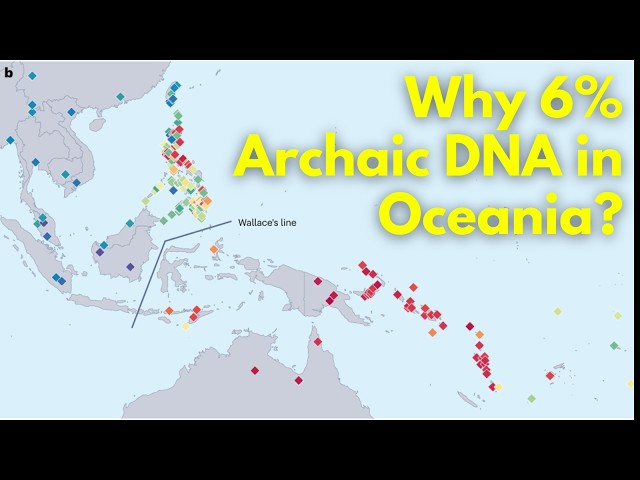
While most people of non-African descent carry about 1.5% to 2% Neanderthal DNA, indigenous populations in Oceania (like Papua New Guinea and Melanesia) carry an additional 3% to 4% of Denisovan DNA. This gives them an "archaic load" of up to 6%, the highest concentration of ancient human DNA in the world today.
The "Perfect Storm" of Geography and Demographics
Oceanians retained this massive amount of ancient DNA due to several unique historical factors:
The Wallace Line & Extreme Isolation: When early humans crossed deep ocean trenches into the ancient continent of Sahul (modern-day Australia and New Guinea), they were cut off from the rest of the world for roughly 50,000 years.
A Unique Denisovan Encounter: Unlike other populations, Oceanians interbred with a distinct, tropical lineage of Australasian Denisovans that only existed east of the Wallace Line.
Zero Genetic Dilution: In Europe and Asia, archaic DNA was gradually "watered down" by later migrations of populations with clean, non-archaic DNA (like early farmers). Because Oceania was completely isolated, their foundational ancient DNA was never diluted.
The Archaic Survival Toolkit (Natural Selection)
This ancient DNA wasn't just kept by accident; it was highly favored by natural selection because it helped modern humans survive extreme environments:
Neanderthal Immune Boosts: Neanderthal genes (like the OAS and Toll-like receptor clusters) provided an aggressive, highly reactive immune response crucial for fighting off lethal tropical viruses and bacteria.
Denisovan Regulators: Denisovan genes (like TNFAIP3) acted as an emergency brake for the immune system, preventing fatal autoimmune reactions or sepsis from chronic parasitic infections.
Hyper-Local Adaptations: The ancient DNA acted as a genetic "switchboard." For example, Papuan lowlanders retained Denisovan genes that fight malaria, while highlanders retained variants that protect the brain from oxygen deprivation at high altitudes.
Show More Show Less View Video Transcript
0:03
The story of how Homo sapiens spread
0:05
across the globe is far more complex
0:06
than a simple journey out of Africa.
0:09
Instead of a straight, unbroken line of
0:11
travel, our evolutionary history looks
0:13
more like a tangled web. As our
0:15
ancestors moved across Europe, Asia, and
0:18
the islands of Southeast Asia, they
0:20
didn't just replace the ancient humans
0:22
already living there. They mingled and
0:24
interbred with them. Today, thanks to
0:27
advanced DNA sequencing, we know that
0:29
almost everyone of non-African descent
0:31
carries about 2% Neanderthal DNA.
0:34
However, the indigenous populations of
0:36
Papua New Guinea, the Bismar
0:38
archipelago, and the broader regions of
0:40
Melanesia hold a fascinating genetic
0:42
anomaly.
0:44
In addition to that standard 2%
0:46
Neanderthal DNA, these Oceananian
0:48
populations carry an extra 3% to 4% of
0:51
Denisven DNA. This means some Melanesian
0:54
groups have an archaic load approaching
0:56
6%. Giving them the highest percentage
0:59
of ancient human DNA of anyone alive
1:01
today. How did a population living in
1:03
the tropical extremes of the southern
1:05
hemisphere end up with the highest
1:07
genetic legacy of ancient humans?
1:09
Especially when Denisovven fossils were
1:11
originally discovered in freezing high
1:13
alitude caves in Siberia. The answer
1:16
isn't just one single event. It is the
1:19
result of several historical and
1:20
ecological factors coming together
1:22
perfectly. Oceanians possess the world's
1:25
highest levels of ancient DNA due to a
1:27
perfect evolutionary storm. As small
1:30
bands of early humans migrated into the
1:32
isolated continent of Sahul, they
1:34
interbred with highly diverse Denisovven
1:36
populations. This extreme geographic
1:39
isolation prevented the later genetic
1:40
[music] dilution that swept across
1:42
Eurasia, permanently locking these
1:45
archaic genes into their foundational
1:47
gene pool. Ultimately, natural selection
1:50
heavily favored this ancient DNA because
1:52
it provided a ready-made survival
1:54
toolkit, equipping them with the exact
1:56
immune and metabolic adaptations needed
1:59
to conquer severe tropical pathogens and
2:01
extreme [music] altitudes.
2:03
To truly understand how ancient human
2:05
DNA is spread across the globe today, we
2:08
have to look at the exact amounts of
2:09
Neanderthal and Denisven genes carried
2:12
by different populations. While anyone
2:14
with non-affrican heritage carries clear
2:16
traces of this ancient mixing, the
2:18
specific ancestors, the timing of these
2:20
encounters, and the sheer amount of DNA
2:23
left behind vary wildly depending on
2:25
where you look in the world. Neanderthal
2:28
ancestry is a universal feature of the
2:30
human genome outside of subsahara and
2:32
Africa, but it isn't sprinkled evenly.
2:35
People of European and West Asian
2:36
descent carry slightly less Neanderthal
2:38
DNA than populations in East Asia,
2:41
though generally this ancient genetic
2:43
signature hovers around 1.5 to 2% across
2:46
these groups. Indigenous populations in
2:49
Papa New Guinea and Australia also share
2:51
this baseline, carrying about 2%
2:54
Neanderthal DNA in their genomes.
2:56
Interestingly, modern genetic tools are
2:58
quite good at spotting this DNA,
3:00
successfully identifying about 72% of
3:03
true Neanderthal segments. This high
3:06
success rate is because the sequenced
3:08
DNA from the famous Ali Neanderthal is
3:11
actually quite similar to the specific
3:13
Neanderthal group that originally
3:14
mingled with early modern humans. While
3:17
Neanderthal DNA shifts only slightly
3:19
from west to east, looking at Denisovan
3:22
DNA reveals a massive sudden spike in
3:25
Oceanania. Across most of Europe,
3:28
Denisovven DNA is essentially absent.
3:31
And in Eastern South Asia, it is merely
3:33
a genetic whisper, making up less than
3:36
0.1% of a person's genome. However, once
3:40
you cross the deep water Wallace line
3:41
into island Southeast Asia and
3:43
Oceanania, the picture changes
3:45
dramatically. Indigenous populations
3:47
like Papuans, Aboriginal Australians,
3:49
and certain groups in the Philippines
3:51
show an incredible surge in Denisavan
3:54
ancestry.
3:55
In Papua New Guinea, this ancient
3:57
genetic load sits robustly between 3 and
4:00
4% with some isolated Melanesian groups
4:03
potentially carrying up to 6%. When you
4:05
look at the sheer physical length of
4:07
these ancient genetic sequences in the
4:09
DNA, the contrast is even more
4:11
staggering. Papan genomes hold a vastly
4:14
larger reservoir of Denisven DNA
4:17
compared to anyone else on Earth,
4:19
encompassing roughly 212 megabases of
4:21
Denisvenlike sequences. This completely
4:24
dwarfs the roughly 45 to 50 megabases
4:27
found in East and South Asian
4:28
populations and the mere trace amounts
4:30
found in Europeans.
4:32
What makes this Papuan genetic wealth
4:35
even more fascinating is how hard it is
4:37
to detect. Unlike the easily spotted
4:40
Neanderthal genes, current science only
4:42
captures about 24% of the true Denisovan
4:46
ancestry in Oceananians. This low
4:48
detection rate happens because the
4:50
Denisovans who lived in freezing
4:52
Siberian caves, the ones we have
4:54
reference DNA for, were deeply
4:56
genetically different from the
4:58
mysterious, likely tropical Denisovvens
5:01
who actually met and mingled with the
5:03
ancestors of Papuans and Australians.
5:06
Even the standard 2% of Neanderthal DNA
5:08
found in Papawans hides some complex
5:11
structural secrets. The variety of
5:13
Neanderthal DNA in Papuans is much lower
5:16
than in Eurasians and Papuan individuals
5:18
tend to share the exact same archaic
5:20
sequences with each other. This pattern
5:22
heavily suggests that they didn't get
5:24
this DNA from directly meeting
5:26
Neanderthalss in Southeast Asia.
5:28
Instead, this Neanderthal DNA was likely
5:31
carried into the region by advancing
5:33
waves of modern humans who had already
5:34
mixed with Neanderthalss much earlier
5:36
back in mainland Eurasia. Yet, this tidy
5:40
explanation is disrupted by a major
5:42
genetic twist. Scientists have found
5:45
highly specific Neanderthalike sequences
5:47
in Papua Newu Guinea that are completely
5:49
missing from all Eurasian populations.
5:52
When researchers look closely at these
5:54
unique sequences, they don't look like
5:56
standard Neanderthal DNA at all.
5:58
Instead, they appear much closer to
6:00
Dennisovven DNA. This structural
6:02
mismatch suggest a thrilling
6:04
possibility. The ancestors of modern
6:07
Papuans may have interbred with a
6:08
completely unknown ghost population of
6:11
ancient humans. This mystery group might
6:13
have been a deep hybrid of Neanderthalss
6:15
and Denisven or perhaps an entirely
6:18
distinct branch of the human family tree
6:20
sitting right between the two known
6:21
species. New Guinea's high concentration
6:24
of ancient DNA stems from complex
6:26
overlaps of human species across pleaene
6:28
Asia. As modern humans expanded, they
6:32
experienced multiple distinct mixing
6:34
events with diverse archaic populations
6:36
rather than a single encounter. Genomic
6:39
modeling reveals a distinct timeline for
6:41
these events. The earliest mixing
6:43
involved Siberian alidenis and the
6:45
ancestors of modern Eurasians between
6:48
120,000 and 94,000 years ago, leaving
6:51
only trace amounts of DNA. Later,
6:54
between 64,000 and 61,900 years ago, a
6:58
massive independent interbreeding event
7:00
occurred between a unique Australasian
7:02
denisonven lineage and the ancestors of
7:04
Oceananians. This predated both the
7:07
primary Neanderthal mixing that affected
7:09
all non-affrican populations around
7:11
47,000 years ago and a subsequent
7:14
Neanderthal wave in Asia between
7:16
35,28,900
7:20
years ago. This exact sequence locked
7:23
the heavy Denisven signature into
7:25
Oceanania early during its initial
7:27
settlement. Initially thought to be a
7:30
localized cold adapted Siberian group,
7:32
genetic data proves Denisven were
7:34
actually widespread and highly diverse.
7:37
Modern humans encountered at least three
7:39
distinct lineages. The original Alai
7:41
group leaving trace DNA in East Asia, an
7:44
Asian/Indian lineage that split off
7:46
roughly 363,000
7:48
years ago, and a highly divergent
7:51
tropical Australasian lineage. This
7:53
third group which bred almost
7:55
exclusively with Oceananian ancestors is
7:58
as genetically distinct from other
7:59
Denisvens as Denisvens are from
8:01
Neanderthalss. Papuan genomes actually
8:04
reveal two distinct Denovven DNA peaks
8:07
indicating hybridization with two
8:09
separate subopuls of this Australasian
8:11
lineage. Emerging evidence suggests
8:13
these dentans may have coexisted with
8:15
modern humans in New Guinea until 30,000
8:18
or possibly 15,000 years ago,
8:20
potentially making them the last archaic
8:22
humans to survive alongside us. The
8:25
Wallace line, a deep water ocean trench,
8:28
acted as a crucial genetic filter. Since
8:31
Dennisan DNA is largely absent in
8:33
mainland Asia, this specific
8:35
interbreeding likely occurred strictly
8:37
east of the barrier. This formidable
8:39
trench prevented a mixed populations
8:41
from migrating back west, permanently
8:44
isolating Oceanania's immense Denisan
8:46
genetic legacy. The exceptionally high
8:48
levels of archaic DNA in Oceanania are
8:51
rooted in the region's dramatic early
8:53
demographic shifts. When the ancestors
8:56
of modern Papuans migrated to the
8:57
prehistoric continent of Sahul around
9:00
60,000 to 65,000 years ago, they
9:03
navigated treacherous oceanic straits in
9:05
small isolated bands.
9:08
These perilous crossings created a
9:10
massive genetic bottleneck. Through the
9:12
powerful evolutionary force of genetic
9:14
drift, the Dennisovven and Neanderthal
9:17
DNA carried by these pioneers [music]
9:19
became permanently locked into their
9:20
small foundational gene pool. Following
9:23
this initial settlement, these
9:25
populations experienced profound
9:27
geographic isolation.
9:29
While Eurasia underwent constant
9:31
migrations and genetic mixing, Melanesia
9:34
remained entirely cut off from global
9:36
networks for roughly 50,000 years. Even
9:39
when Aranesian speaking Lepita seafarers
9:41
arrived 3,000 years ago, significant
9:43
genetic mixing with indigenous papans
9:45
did not begin for nearly a millennium.
9:48
This extraordinary prolonged isolation
9:50
ensured that the ancient pleaene genomic
9:52
blueprint survived into modern times
9:54
completely untouched and undiluted. The
9:57
reason populations in Papua New Guinea
9:59
carry the world's highest concentrations
10:01
of ancient DNA is equally driven by the
10:04
massive genetic dilution that occurred
10:06
across Western Eurasia over the past
10:08
30,000 years. This dilution began with
10:11
the Basil Eurasian lineage, a ghost
10:14
population that diverged before early
10:16
humans ever encountered Neanderthalss,
10:18
meaning they carried entirely clean,
10:20
non-archic DNA.
10:23
Around 26,000 years ago, these bustel
10:26
Eurasians mixed with established West
10:28
Eurasian hunter gatherers, permanently
10:30
watering down the existing Neanderthal
10:32
ancestry in Middle Eastern and European
10:34
populations. A second major dilution was
10:36
driven by the Neolithic Revolution.
10:39
Early European farmers who carried
10:41
exceptionally high proportions of this
10:42
basal Eurasian ancestry expanded
10:45
massively from the near east into the
10:47
European continent. As this
10:49
exponentially growing population
10:51
assimilated the indigenous Paleolithic
10:53
hunter gatherers, this continental ad
10:55
mixture drove overall Neanderthal DNA in
10:58
Europe down to the 1.5 to 2.0% observed
11:01
today. Because the isolated populations
11:04
of Oceanania completely missed both the
11:06
basal Eurasian gene flow and the later
11:08
Neolithic farming expansions, they
11:10
experienced absolutely zero genetic
11:13
dilution, perfectly preserving the
11:15
ancient genetic baseline they
11:17
established in Sahul 60,000 [music]
11:19
years ago. While population bottlenecks
11:22
and complete geographic isolation
11:24
elegantly explain the sheer volume of
11:26
archaic DNA preserved in Oceanania,
11:28
these neutral demographic processes only
11:30
tell half the story. Genetic drift acts
11:33
randomly. But when we look closely at
11:35
the genomes of modern Melanesians,
11:38
specific archaic gene sequences show up
11:40
at frequencies [music] far too high to
11:42
be a mere statistical accident. These
11:44
sequences carry the unmistakable
11:46
mathematical signature of positive
11:48
natural selection. When anatomically
11:50
modern humans finally pushed into
11:52
Wallacea and Seahul, they were entering
11:55
extreme tropical environments tens of
11:57
thousands of years after Denisven and
11:59
Neanderthalss had already mastered them.
12:01
By interbreeding, our ancestors
12:03
essentially executed a brilliant
12:05
evolutionary shortcut, absorbing a
12:07
ready-made reservoir of advantageous
12:09
locally adapted genes. The deep tropical
12:12
biomes of island Southeast Asia and New
12:14
Guinea present a formidable, often
12:16
lethal, infectious disease burden.
12:19
It makes perfect sense that the most
12:21
prominent targets of this adaptive
12:23
introgression involve complex gene
12:24
clusters that regulate our innate
12:26
immunity. For instance, the OAS gene
12:29
locus, which encodes vital antiviral
12:31
proteins that fight off RNA viruses, was
12:34
profoundly shaped by an introgressed
12:36
Neanderthal sequence. This specific
12:38
genetic alteration doesn't just change
12:40
the gene. It creates an alternative
12:42
protein with significantly higher
12:44
enzyatic activity, triggering a
12:46
hyperactive antiviral response that
12:48
would have been a massive survival
12:50
advantage in a pathogen-dense jungle.
12:52
Another prime example of a Neanderthal
12:54
survival gift is found in the toll-like
12:56
receptor cluster. These cellular
12:58
receptors act as our immune systems
13:00
frontline biochemical sensors,
13:03
constantly on the lookout for invading
13:04
bacteria and viruses. Fascinatingly,
13:08
this archaic genetic sequence functions
13:10
like a highly sophisticated trip wire.
13:12
In unstimulated blood, the Neanderthal
13:15
DNA stays quiet and shows no significant
13:17
impact. But the moment the body detects
13:20
a pathogenic threat, these ancient alals
13:22
drive a rapid explosive surge in immune
13:24
cell activation. This precise ondemand
13:27
immune escalation provided a decisive
13:30
advantage against local microbes and
13:32
continues to influence modern human
13:34
susceptibility to specific allergies and
13:37
stomach bacteria today. While the
13:39
Neanderthalss provided aggressive immune
13:41
boosters, the Denisven offered something
13:44
equally critical for surviving the
13:45
tropics, a master switch to prevent the
13:47
body from destroying itself. Melanesians
13:50
possess a highly specific and potent
13:52
Denisovven sequence spanning the TNF
13:54
AIP3 gene. This gene is absolutely vital
13:58
for calming down the innate immune
14:00
system after it has been triggered by
14:02
actively preventing an uncontrolled
14:04
inflammatory cascade. This Denisven
14:06
variant likely saved early populations
14:08
from fatal autoimmune reactions or
14:10
sepsis, which are common and deadly
14:12
risks when dealing with chronic tropical
14:14
parasitic infections.
14:16
The true power of ancient DNA in
14:18
Oceanania lies in its role as a genetic
14:21
switchboard. Instead of building
14:23
entirely new proteins, these archaic
14:25
genes primarily act as regulators,
14:27
finely tuning how modern human genes
14:29
respond to intense environmental
14:31
pressures, such as adjusting skin
14:33
pigmentation to handle the blistering
14:35
tropical sun. By inheriting these
14:37
regulatory variants, early humans gained
14:40
an immediate environmentally driven
14:42
adaptation fine-tuned by ancestors who
14:45
had mastered those landscapes long
14:46
before them. This highly localized
14:49
adaptation is perfectly illustrated by
14:51
comparing two distinct populations in
14:53
Papua New Guinea, the Lowlanders of Daru
14:55
Island and the Highlanders of Mount
14:57
Wilhelm. While both groups share a
14:59
baseline of Neanderthal DNA, the
15:02
specific Denisovven genes they retained
15:04
diverge drastically to match their
15:06
unique survival needs. In the tropical
15:09
lowlands, where malaria is a constant
15:11
and lethal threat, the surviving
15:13
Dennisan genes hypercharge the immune
15:16
systems proteins to aggressively fight
15:18
off intracellular parasites. Conversely,
15:21
the Highlanders face freezing
15:23
temperatures and severe oxygen
15:25
deprivation. In this extreme
15:27
environment, the Dennisovven DNA shifts
15:30
its focus entirely from immunity to
15:32
neurology, specifically targeting early
15:35
brain development to protect delicate
15:36
tissue from hypoxia. Fascinatingly, this
15:39
rapid evolutionary leap occurred
15:41
completely independently of the high
15:43
alitude adaptations seen in Tibetan
15:45
populations, proving these ancient
15:47
genetic switches provided a highly
15:49
customized rapid response survival
15:51
toolkit. While positive selection
15:54
elegantly explains why these beneficial
15:56
ancient genes survived, evolutionary
15:58
history is just as much about what was
16:01
lost. The fact that Oceananians retain
16:03
up to 6% archaic DNA means that a
16:06
massive 94 to 97% of their genome
16:08
remains strictly and exclusively modern
16:11
human. When divergent species like
16:13
modern humans and denisven hybridize
16:16
after hundreds of thousands of years of
16:18
separate evolution, deep biological
16:20
incompatibilities inevitably arise. This
16:23
biological friction triggered a massive
16:25
systemic genetic purge, ruthlessly
16:28
removing archaic varants that disrupted
16:30
our fundamental biological networks. The
16:33
clearer signature of this systemic purge
16:35
is observed on the X chromosome which is
16:37
depleted of both Neanderthal and
16:39
Denisavan DNA relative to the rest of
16:41
the genome. Because the mamalian X
16:44
chromosome is densely packed with genes
16:46
governing male fertility, this massive
16:49
depletion strongly suggests that early
16:51
male hybrids resulting from these
16:52
ancient pairings likely experienced
16:55
severely reduced fertility or outright
16:57
sterility. Natural selection rapidly
17:00
recognized this evolutionary dead end
17:02
and purged these incompatible archaic
17:04
sequences from the surviving human
17:05
lineages. Beyond the sex chromosomes,
17:08
scientists have mapped massive
17:10
continuous stretches across the human
17:12
genome, some over 20 million base pairs
17:14
long, that are completely devoid of any
17:16
archaic DNA. Geneticists call these
17:19
vital zones archaic deserts. These
17:22
deserts represent the core biological
17:24
traits that fundamentally distinguish
17:26
modern humans from our extinct cousins.
17:28
For instance, the largest archaic desert
17:31
contains the fox P2 gene, which is
17:33
absolutely essential for modern human
17:35
speech and complex language processing.
17:38
The absolute absence of ancient DNA here
17:41
implies that our highly specific
17:42
neurological circuitry for vocalization
17:45
simply could not accommodate Denisan or
17:47
Neanderthal genetic interference.
17:49
Similarly, these deserts are heavily
17:50
populated by genes controlling the
17:52
physical structure of our skin,
17:54
specifically keratin. While early humans
17:57
happily borrowed archaic regulatory
17:59
switches to adjust their skin color for
18:01
UV protection, the actual physical
18:03
structural formation of the epidermal
18:05
layers seemingly required strictly
18:07
modern human DNA. Any archaic deviation
18:10
in these foundational building blocks
18:11
was likely highly disruptive and swiftly
18:13
eliminated. Ultimately, the survival of
18:16
that 6% archaic DNA in Papua New Guinea
18:19
is not a random accident. It is the
18:21
highly refined survival tested fraction
18:24
of a massive ancestral hybridization
18:27
experiment, leaving us with a
18:28
spectacular living record of our complex
18:30
evolutionary journey.
18:35
>> [music]
#Biological Sciences
#Genetics