Up next in 10


The Neanderthal Exclusion: Why They Never Entered Africa
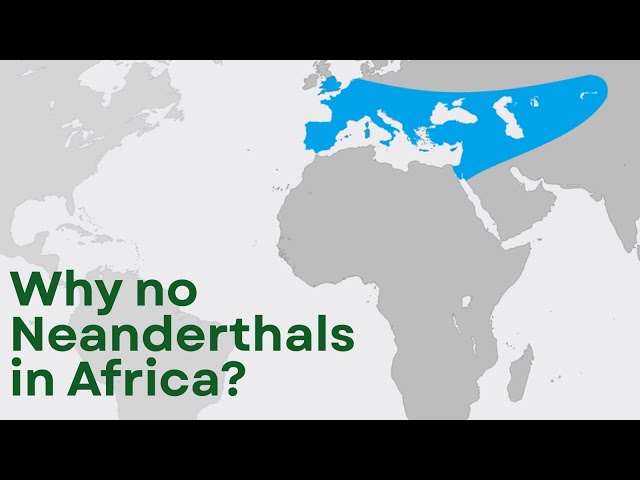
Despite dominating Eurasia from Portugal to Siberia for hundreds of thousands of years, Neanderthals never set foot on the African continent. This is one of the great anomalies of human evolution, especially given that they lived in the Levant (modern-day Israel), just a few hundred kilometers from the African gateway.
The "Neanderthal Exclusion" wasn't just bad luck; it was caused by a "perfect storm" of four impassable barriers:
1. The Climate Trap (The Desert Filter) The Saharo-Arabian desert belt acted as a swinging door. When the Sahara was green, Homo sapiens moved north. But when the climate cooled—pushing Neanderthals south into the Levant—the Sahara turned into a hyper-arid desert. Neanderthals arrived at the doorstep of Africa only to find the door slammed shut by a wall of sand and heat.
2. Physiological Mismatch Neanderthals were biological machines built for the Ice Age. Following Bergmann’s rule, they were stocky with short limbs to conserve heat. In the African tropics, this advantage became a death sentence. They could not dissipate heat efficiently and required significantly more energy to move than the lanky, heat-adapted Homo sapiens. The African environment was physically unsustainable for their body type.
3. The Biotic Barrier (Competition) Africa wasn't empty; it was the stronghold of Homo sapiens. Modern humans in Africa had higher population densities and advanced projectile technology (like the Aterian tanged points). For Neanderthals to enter, they would have had to displace a denser, better-equipped population on their home turf—a nearly impossible feat.
4. The Disease Wall (The Invisible Killer) Perhaps the strongest barrier was invisible. Africa, being the cradle of humanity, was also the cradle of human pathogens (malaria, sleeping sickness, etc.). Homo sapiens had co-evolved immunity to these tropical diseases. Neanderthals, having adapted to the sterile, cold environments of Europe, possessed "naïve" immune systems. Stepping into Africa would have exposed them to a viral and parasitic load that would have caused catastrophic population collapse.
Show More Show Less View Video Transcript
0:02
The evolutionary history of the genus
0:03
Homo during the plea scene is
0:05
characterized by a complex rhythm of
0:07
dispersals, range contractions, and
0:10
regional adaptations driven by the
0:12
oscillating engine of global climate
0:13
change. Among the various homminin
0:16
lineages that populated the old world,
0:18
Homo Neanderthalencis stands out as the
0:20
quintessential Eurasian specialist.
0:22
Emerging from middle pleaene ancestors
0:25
often categorized as homohidal
0:27
beagensis, Neanderthal successfully
0:29
colonized a vast longitudinal range
0:32
extending from the Atlantic precipaces
0:34
of Portugal to the alti mountains of
0:36
Siberia and latitudinally from the
0:38
glaciated margins of northern Europe to
0:40
the Mediterranean woodlands of the
0:41
Levant. Yet despite this extensive
0:44
colonization and their survival through
0:46
multiple glacial cycles, a conspicuous
0:49
and scientifically provocative void
0:51
exists in their distribution, the
0:53
African continent. The absence of
0:56
Neanderthalss in Africa represents one
0:58
of the most significant biogeographical
1:00
anomalies in paleo anthropology. Africa,
1:03
the undisputed cradle of the human
1:05
lineage and the source of multiple
1:07
dispersal waves, including Homo erectus,
1:10
Homohidal begensis, and eventually Homo
1:13
sapiens appears to have functioned as a
1:15
one-way valve for much of the late
1:17
pleaene. While homminins repeatedly
1:20
exited the continent to populate
1:21
Eurasia, the reciprocal movement of
1:23
Eurasian taxa back into Africa appears
1:26
restricted, particularly for the
1:27
Neanderthalss.
1:29
This restriction is all the more
1:30
perplexing given the geographical
1:32
proximity of the Neanderthal
1:33
southernmost range in the Levant to the
1:35
African gateway at the Sinai Peninsula,
1:38
a distance of mere hundreds of kilome.
1:40
The Neanderthal exclusion raises
1:42
fundamental questions about the nature
1:44
of biological barriers in human
1:46
evolution seemingly driven by a perfect
1:48
stormia of impossible aridity,
1:50
physiological constraints, and
1:52
competitive exclusion by indigenous
1:54
African populations.
1:56
To understand why Neanderthalss did not
1:58
enter Africa, one must first examine the
2:01
fossil record which defines the absolute
2:03
southern limit of their range. The
2:05
Levant encompassing modern-day Israel,
2:08
Palestine, Lebanon, Jordan, and Syria
2:10
represents the confirmed southern
2:12
terminus of the Neanderthal expansion.
2:15
This region acted as a biogeographical
2:17
bridge between Africa and Eurasia. But
2:19
for Neanderthalss, it appears to have
2:21
functioned as a distinct culdeac.
2:23
Excavations in the Mediterranean coastal
2:25
ranges and the Galilee have yielded
2:27
robust and undisputed Neanderthal
2:29
fossils at sites such as Taboon, Cabara,
2:31
[music]
2:31
and Ammud. The distribution of these
2:34
sites is telling. They're clustered in
2:36
the Mediterranean woodland zone, an
2:38
environment that especially during
2:40
glacial periods resembled the temperate
2:42
woodlands of southern Europe. Crucially,
2:46
diagnostic Neanderthal fossils have
2:48
never been found south of the Judeian
2:50
Hills and Ngev line. While the vast
2:52
expanse of the Negev desert, the Sinai
2:55
Peninsula, and the Arabian Peninsula has
2:57
yielded middle Paleolithic stone tools,
2:59
it lacks Neanderthal skeletal remains,
3:02
suggesting that the Arab boundary of the
3:03
Negev acted as a hard limit for the
3:05
species. The chronology of this
3:08
occupation is equally significant.
3:10
Dating suggests an alternating pattern
3:12
of occupation between Neanderthalss and
3:14
anatomically modern humans driven by
3:16
climatic oscillations. During the warm
3:19
marine isotope stage 5 around 130 to
3:22
74,000 years ago, the region was
3:25
generally associated with modern humans.
3:27
However, during the global glacial phase
3:30
of marine isotope stage 4 around 71 to
3:33
57,000 years ago, the Levant became
3:35
cooler and drier leading to the
3:37
reemergence of Neanderthalss who were
3:39
likely pushed south by harsh conditions
3:41
in Europe and Anatolia. This timing is
3:43
critical because Neandthals expanded
3:45
into the Levant precisely when the
3:47
global climate was deteriorating, a
3:50
period that coincided with hyperaridity
3:52
in the Saharan barrier to the south,
3:54
effectively trapping them in the
3:56
Levventine corridor. In the early and
3:58
mid 20th century, the discovery of
3:59
robust homminin fossils in North Africa
4:02
led to significant taxonomic confusion
4:04
and the hypothesis that Neanderthalss
4:06
had indeed crossed into Africa.
4:09
Specimens from sites like Jebel Hood in
4:12
Morocco and how in Libya were frequently
4:15
described as Neanderthaloid due to
4:17
superficial similarities such as heavy
4:19
brow ridges. However, modern science has
4:22
dismantled this hypothesis. A major
4:24
breakthrough occurred in 2017 when
4:26
fossils from Jebel herd were redated to
4:29
approximately 315,000 years ago and
4:32
reanalyzed [music]
4:33
using geometric morphometrics.
4:35
This analysis revealed that while the
4:37
specimens possess archaic features
4:39
[music] like a long low brain case,
4:41
their facial morphology is essentially
4:42
modern and lacks diagnostic neanderthal
4:45
traits such as midfacial prognithism and
4:48
specific inner ear structures.
4:50
Consequently, Jabel Hood is now
4:52
recognized as representing the earliest
4:54
known cate of homo sapiens termed early
4:58
anatomically modern humans. Similar
5:01
re-evaluations of other North African
5:02
fossils have confirmed their affinity
5:04
with early homo sapiens rather than
5:06
Neanderthalss, leaving zero confirmed
5:09
skeletal evidence of Homo
5:10
Neanderthalencis on the African
5:12
continent. The advent of paleogenomics
5:15
has further clarified the picture,
5:17
distinguishing between physical presence
5:19
and secondary genetic introgression.
5:22
While initial sequencing suggested
5:23
subsahara and Africans possessed no
5:25
Neanderthal DNA, more sophisticated
5:28
algorithms have recently detected
5:29
Neanderthal ancestry in modern African
5:31
populations at levels ranging from.3% to
5:35
1%. Crucially, analysis of the specific
5:38
hllet types indicates that this DNA
5:40
entered Africa via the back migration of
5:42
anatomically modern humans from Eurasia.
5:44
This means that homo sapiens left
5:46
Africa, hybridized with Neanderthalss in
5:49
the Levantal Europe, and a subset of
5:51
these mixed populations subsequently
5:53
migrated back into Africa, spreading
5:55
Neanderthal alals into the African gene
5:58
pool. Thus, the Neanderthal signal in
6:00
Africa is evidence of human mobility,
6:02
not Neanderthal mobility. Furthermore, a
6:05
distinct ghost archaic signal found in
6:08
West African populations, often confused
6:10
with Neanderthal ancestry, has been
6:12
shown to diverge from the modern human
6:14
lineage well before the Neanderthal
6:16
split, confirming it as an ancient
6:18
autothonus African homminin lineage
6:20
rather than a Eurasian intruder.
6:23
The absence of basil Neanderthal
6:25
mitochondrial DNA in ancient or modern
6:28
African populations further reinforces
6:30
the conclusion that Neanderthal women
6:32
did not enter Africa to establish
6:34
maternal lineages. If the genetic and
6:36
fossil evidence confirms absence, the
6:39
mechanism of exclusion lies largely in
6:41
the extreme climatic oscillations of the
6:43
Saharro Arabian desert belt. This region
6:46
acted as a biogeographical filter,
6:49
permeable to some but impossible to
6:51
others depending on the climatic phase.
6:53
During the green Sahara episodes of
6:55
Marine isotope stage 5, high rainfall
6:58
and river systems connected the African
7:00
interior to the Mediterranean, allowing
7:02
Homo sapiens to expand northward.
7:04
However, during this warm period,
7:07
Neanderthalss largely retreated into
7:09
northern and central Europe. Conversely,
7:11
during the glacial maximum of marine
7:13
isotope stage 4, when cooling pushed
7:16
Neanderthal south into the Levant, the
7:18
Sahara experienced hyperidity.
7:20
The Green Sahara collapsed and the
7:23
desert barrier reestablished itself with
7:24
ferocity. Neanderthalss arriving at the
7:27
Levventine Gateway were effectively
7:29
blocked from further southward expansion
7:30
by a wall of sand and heat trapped in
7:32
the Mediterranean woodland corridor.
7:35
Pollen analyses confirm that while the
7:37
northern Levant retained woodlands, the
7:39
south turned to step and desert
7:41
vegetation, environments to which
7:43
Neanderthal showed no archaeological
7:45
evidence of adaptation. Physiological
7:48
constraints further solidified this
7:50
barrier. The Neanderthal body plan was a
7:52
highly specialized apparatus for heat
7:54
conservation evolved over hundreds of
7:57
thousands of years in the glacial
7:58
environments of Europe. Following
8:00
Bergman's and Allen's rules, they
8:02
possessed high body mass relative to
8:04
surface area and shortened distal limb
8:06
segments to minimize heat loss. In the
8:09
hot arid environments of the Sahara or
8:11
tropical Africa, this cold adapted
8:13
morphology would have become a
8:14
significant liability.
8:16
The primary physiological challenge in
8:18
such environments is heat dissipation
8:21
for which the linear tropical build of
8:23
homo sapiens is optimized. A Neanderthal
8:26
in the same environment would suffer
8:27
significantly higher heat stress and
8:29
water requirements. Additionally,
8:31
bioenergetic modeling suggests that the
8:33
short-legged Neanderthal body plan was
8:35
less efficient for long-distance
8:37
locomotion, requiring significantly more
8:39
energy to move the same distance as
8:41
modern humans. This would have placed
8:44
them at a severe disadvantage in
8:45
crossing the vast resource poor
8:47
distances of the S Arabian desert belt.
8:50
Beyond the physical and physiological
8:52
barriers, Neanderthalss faced a
8:54
formidable biotic barrier. The African
8:56
continent was already fully occupied by
8:58
Homo sapiens. Ecological theory posits
9:01
that migration requires entering a niche
9:04
and if that niche is occupied by a
9:06
competitor with equal or superior
9:07
adaptation, competitive exclusion
9:09
occurs. African homo sapiens populations
9:12
likely maintained higher effective
9:14
population sizes and genetic diversity
9:17
than the smaller more inbred Neanderthal
9:19
populations of Eurasia. Furthermore, by
9:22
marine isotope stage 4 and three,
9:24
African populations possessed advanced
9:26
technological advantages such as the
9:28
complex projectile technology seen in
9:30
the industry which includes tenured
9:32
points indicative of hafting and
9:35
potentially archery. While thean
9:37
industry shares the level reduction
9:39
strategy with the Neanderthion,
9:42
this is regarded as technological
9:44
convergence or retention from a common
9:46
ancestor, not evidence of Neanderthal
9:48
presence. The unique Tyrion tanged
9:50
points are morphologically distinct and
9:52
represent a sophisticated African
9:54
tradition. Any Neanderthal incursion
9:56
would have required displacing these
9:57
denser, better adapted populations on
10:00
their home turf, a scenario highly
10:02
unfavorable to the invader. The disease
10:05
barrier hypothesis provides a compelling
10:07
explanation for why Neanderthalss never
10:09
successfully colonized Africa. To
10:12
understand this fully, we must look at
10:14
the specific dynamics of pathogen
10:16
ecology, evolutionary immunology, and
10:18
the geographic bottleneck of the Levant,
10:20
the Middle East. The fundamental driver
10:23
of this barrier was the ecological
10:25
difference between Africa and Eurasia.
10:27
Africa is the evolutionary cradle of
10:28
primates, meaning humans and their
10:30
pathogens co-evolved there for millions
10:33
of years. The tropical climate supports
10:35
a massive biodiversity of vectors,
10:37
mosquitoes, ticks, flies, and snails,
10:41
allowing complex life cycles for
10:43
parasites like malaria, sleeping
10:45
sickness, and shistos.
10:48
When the ancestors of Neanderthalss left
10:50
Africa hundreds of thousands of years
10:51
ago, they moved into the temperate and
10:54
subglacial environments of Europe. The
10:56
cold winters there acted as a natural
10:58
sterilization cycle, killing off insect
11:01
vectors and reducing pathogen diversity.
11:05
Over roughly 500,000 years, the
11:07
Neanderthal immune system adapted to
11:09
this cleaner environment, likely losing
11:12
the costly and aggressive genetic
11:13
defenses needed to survive the intense
11:15
pathogenic assault of the tropics.
11:18
When Neanderthalss expanded south toward
11:20
the Levant, modern-day Israel of
11:22
Palestine, they weren't just meeting
11:24
rival hunters. They were walking into a
11:26
biological wall.
11:29
The African homo sapiens living in this
11:31
region carried a potent arsenal of
11:32
tropical diseases to which they were
11:34
tolerant. But Neanderthalss were not.
11:37
Likely candidates include ancestral
11:39
strains of tuberculosis, helicaacttop
11:41
pylori associated with stomach [music]
11:43
ulcers and various herpes viruses. For a
11:46
Neanderthal whose immune system was
11:48
nerve to these specific tropical
11:50
strains, close contact would likely
11:52
result in epidemics similar to what
11:53
happened to indigenous populations in
11:55
the Americas after 1492.
11:58
This high mortality rate would have
11:59
caused local extinctions of Neanderthal
12:01
groups attempting to push south,
12:03
effectively creating a border enforced
12:05
by microbes rather than mountains. We
12:08
have concrete evidence of this
12:09
biological warfare in our own DNA. When
12:12
scientists analyze the human genome,
12:14
they find that some of the most common
12:16
Neanderthal DNA segments we retained are
12:19
related to the immune system,
12:20
specifically the human lucasite antigen
12:23
genes. This suggests that when modern
12:25
humans finally did move north, they
12:28
survived only because they mated with
12:30
Neanderthalss and stole their immunity
12:32
to local European diseases like Epstein
12:34
bar or sepsis causing bacteria.
12:37
Conversely, we see almost no evidence of
12:39
homo sapiens immune genes flowing into
12:41
late Neanderthal populations in a way
12:43
that helped them survive. This implies
12:45
that while humans could genetically
12:47
adapt to the lighter disease load of the
12:49
north, Neanderthalss could not evolve
12:51
fast enough to withstand the
12:52
overwhelming tropical burden of the
12:54
south. This creates a picture of
12:56
asymmetrical biological warfare. The
12:59
diseases humans carried were likely
13:00
older, more diverse, and more aggressive
13:03
because they came from the tropics. This
13:05
gave homo sapiens a grim biological
13:07
advantage. While Neanderthal diseases
13:10
certainly held humans back from Europe
13:12
for a long time, the 50,000year
13:14
stalemate in the Middle East, the
13:16
barrier preventing Neanderthalss from
13:18
entering Africa was much thicker. The
13:21
sheer density of African pathogens meant
13:23
that even if a Neanderthal band defeated
13:25
a human band in conflict, the invisible
13:27
army of microbes the humans left behind
13:30
would likely finish the job, preventing
13:32
the Neanderthalss from ever establishing
13:34
a permanent foothold on the African
13:35
continent.
13:37
In conclusion, the absence of
13:39
Neanderthalss in Africa is not the
13:40
result of a single factor, but a
13:43
convergence of barriers forming a
13:44
perfect storm of exclusion. The
13:47
geographic trap of the Sahara Arabian
13:49
desert sealed the southern corridor
13:51
precisely when cooling pushed
13:52
Neanderthalss into the Levant. Their
13:54
cold adapted physiology was
13:56
metabolically ills suited for the heat
13:58
and endurance requirements of the desert
14:00
crossing. Furthermore, they faced a
14:02
demographic wall of technologically
14:04
sophisticated homo sapiens and an
14:06
invisible barrier of tropical pathogens.
14:09
Neanderthalss remained at the threshold
14:11
in the caves of Mount Carmel and
14:12
Galilee, [music] leaving their
14:14
fossilized remains within sight of the
14:16
continent that birthed the genus Homo,
14:18
but which they were biologically and
14:19
ecologically precluded from ever
14:21
entering.
14:25
[music]
#People & Society
#Science