Up next in 10


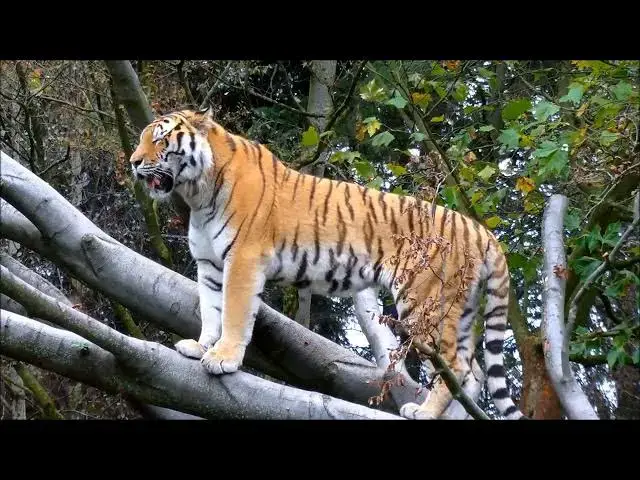
Discover how tiger roars can be heard up to two miles away, even in thick forests. Learn about the science behind their low-frequency vocalizations, how sound waves navigate obstacles, and why this matters for tiger ecology and conservation.
Show More Show Less View Video Transcript
0:00
tiger Roars how they travel through
0:02
dense
0:03
forest the bone chilling Roar of a tiger
0:07
can be heard up to 2 miles away even in
0:10
the densest of
0:12
forests how exactly does this powerful
0:15
sound navigate through the thick
0:16
vegetation of a tiger's
0:18
habitat today we're exploring the
0:21
fascinating world of tiger vocalizations
0:25
and the science behind their
0:27
far-reaching roars
0:30
tiger Roars are unique among big
0:33
cats they produce a low frequency sound
0:37
that can travel long distances without
0:40
losing much
0:41
energy this low frequency typically
0:46
around 20 htz is at the lower limit of
0:49
human hearing the sound is created when
0:52
Tigers push air through their vocal fos
0:55
causing them to
0:57
vibrate the large size of a t vocal FES
1:01
allows for these deep resonant
1:05
vocalizations now let's consider the
1:07
environment these Roars must
1:10
Traverse dense forests are complex
1:13
acoustic
1:15
environments filled with obstacles like
1:18
trees undergrowth and varying
1:21
terrain sound waves typically lose
1:24
energy as they encounter these obstacles
1:27
bouncing off surfaces and being absorbed
1:30
by
1:31
vegetation however the low frequency
1:34
nature of tiger Roars gives them an
1:37
advantage low frequency sounds have
1:40
longer wavelengths which allows them to
1:42
pass around obstacles more easily than
1:45
high frequency
1:46
sounds this characteristic enables tiger
1:49
ruls to maintain their integrity and
1:52
power over long distances even in
1:55
cluttered Forest
1:57
environments the sound waves can affect
1:59
AC ly bend around trees and other
2:02
vegetation reducing the amount of energy
2:04
lost through absorption or
2:07
scattering tigers have also developed
2:09
adaptations in their vocalizations to
2:12
optimize sound transmission in forested
2:15
areas they often Roar from specific
2:19
locations such as clearings or elevated
2:22
areas to maximize the reach of their
2:25
CS additionally tigers can modulate the
2:29
frequency and duration of their Roars
2:31
potentially adjusting them based on the
2:34
density of their
2:35
surroundings the ability of tiger Roars
2:38
to travel through dense forests serve
2:41
several important ecological
2:43
functions these vocalizations play a
2:46
crucial role in territorial marking mate
2:49
attraction and communication between
2:52
individuals the far-reaching nature of
2:55
their Roars allows Tigers to assert
2:57
their presence over large areas without
3:00
having to physically Patrol every inch
3:03
of their
3:04
territory understanding how tiger Roars
3:07
propagate through their habitat is not
3:09
just a matter of scientific
3:12
curiosity it provides valuable insights
3:15
into tiger Behavior habitat use and
3:18
conservation
3:19
needs by studying these vocalizations
3:23
researchers can better estimate tiger
3:25
populations monitor their movements and
3:28
develop more effective conservation
3:31
strategies the remarkable ability of
3:34
tiger Roars to penetrate dense forests
3:37
is a testament to the intricate
3:39
relationship between these magnificent
3:41
predators and their
3:43
environment it showcases the power of
3:46
evolutionary adaptations and the complex
3:49
interplay between animal communication
3:52
and habitat
3:53
ecology as we continue to unravel the
3:56
mysteries of tiger vocalizations we gain
3:59
a deeper appreciation for the subtle yet
4:01
crucial aspects of wildlife conservation
#Pets & Animals
#Wildlife
#Biological Sciences
#Ecology & Environment