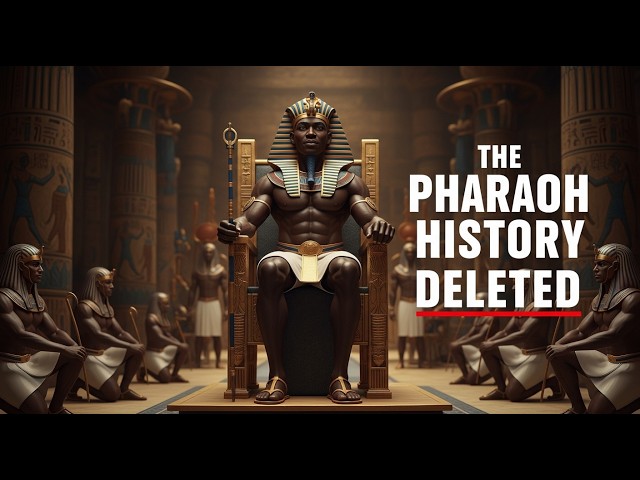

Kushite Pharaohs Conquered Egypt For Nearly 100 Years — Here's Why You Never Heard Of Them
Mar 18, 2026

They built more pyramids than Egypt. They conquered the most powerful throne in the ancient world. And then… someone decided you should never know their name.
The Kingdom of Kush is one of the greatest civilizations in human history — and one of the most deliberately erased. For nearly 100 years, Black African pharaohs sat on Egypt's throne, restored its temples, rebuilt its traditions, and stood toe-to-toe with the Assyrian Empire. One of their queens may have buried the head of a Roman emperor's statue beneath her temple steps — so her people could walk over the face of Rome every single day.
And yet — most people have never heard of them.
In this video, we tell the full, uncut story of the Kingdom of Kush. From its ancient roots along the Nile, to the legendary conquest of Egypt under King Piye, to the rise of the 25th Dynasty, the battle against Assyria, and the deliberate erasure that followed.
This is the story they didn't teach you in school.
IN THIS VIDEO YOU'LL DISCOVER:
→ Why Kush built MORE pyramids than Egypt — and why nobody talks about it
→ The Kushite king who wept over horses but showed no mercy to corrupt princes
→ How Black African pharaohs restored Egypt's divine traditions — better than the Egyptians themselves
→ The one-eyed queen who went to war with Rome — and won
→ Why the erasure of Kush was not an accident — and what it reveals about how history is written
→ The ancient script that still hasn't been fully decoded — and what it might contain
SOURCES & FURTHER READING
→ The Victory Stele of Piye — Gebel Barkal, Sudan (Cairo Museum)
→ The African Origin of Civilization — Cheikh Anta Diop
→ Sudan: Ancient Kingdoms of the Nile — Dietrich Wildung
→ Black Pharaohs — National Geographic, Robert Draper (2008)
→ Oriental Institute, University of Chicago — Nubian Expedition Archives
→ British Museum — Kushite Collection
→ Khartoum National Museum — Meroitic Artifacts
Show More Show Less