Up next in 10


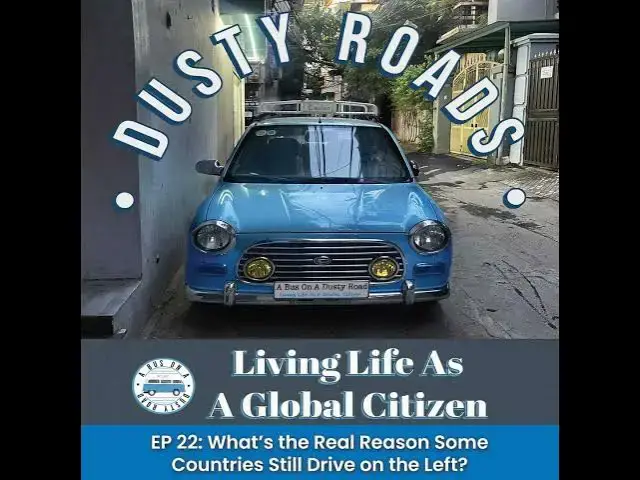
If you’ve ever landed in the UK, Japan, or Thailand and watched cars zip by on the “wrong” side of the road, you’ve likely asked yourself: Why do some countries drive on the left? It feels strange, even disorienting at first, especially if you’re used to driving on the right. But there’s a story behind this quirk, and it’s not just random—it stretches back to ancient times and touches on everything from colonial rule to cultural tradition. Tune in as Anita dives into this fascinating topic on #DustyRoads.
Want to learn more? Click here (https://abusonadustyroad.com/why-do-some-countries-drive-on-the-left-side-of-the-road/) to read the full article.
#WhyDriveOnTheLeft #GlobalTravelTips #DrivingAbroad #CulturalQuirks #DustyRoadsPodcast #TravelCuriosity #RoadRulesWorldwide #LeftSideDriving
Support the show (https://www.paypal.com/globaltradegal)
Show More Show Less View Video Transcript
0:00
[Music]
0:07
Hi, this is Anita from the Dusty Roads
0:09
podcast where we like to talk about all
0:11
things to do with travel and living life
0:13
overseas or as we call living your life
0:15
as a global citizen. We believe that you
0:18
can live your life as a global citizen
0:20
anywhere as long as you just care about
0:22
the world, care about people in the
0:24
world. And today we're going to talk
0:26
about something which maybe some that
0:27
have traveled have seen is they wonder
0:30
why do some countries drive on the left
0:32
side of the road. If you've ever landed
0:34
in the UK or in Hong Kong or Thailand,
0:38
you might wonder why are they driving on
0:40
the other side of the road? And
0:41
sometimes it can get a little bit
0:43
confusing, especially when you're trying
0:44
to cross the road or if you're actually
0:46
renting a car and driving there. I
0:49
didn't realize, but there is some
0:51
reasons why. And here are the eight main
0:53
reasons. The first reason was the
0:55
ancient origins. The left was right. To
0:58
understand left-sided driving, we go
1:00
back to ancient civilizations, including
1:02
the Romans. In ancient Rome, people
1:05
traveled on the left. Why? Because most
1:08
people were right-handed. When walking
1:11
or riding a horse, it was safer and more
1:14
strategic to stay on the left side of
1:16
the road. That way, your dominant hand
1:18
would be free to draw a sword or offer a
1:21
greeting.
1:23
This logic made sense not just in combat
1:26
but in everyday safety. Passing someone
1:29
on your right meant your sword hand
1:31
wasn't exposed.
1:34
So this practice then is stuck for
1:36
centuries. Evidence from old roads like
1:38
wheel rots and Roman paths suggests that
1:41
leftsided travel was the norm in much of
1:44
Europe. However, over time, as nations
1:48
centralized and began building new
1:49
infrastructure, things began to shift.
1:52
France and the United States, for
1:54
example, adopted right side driving
1:56
during and after the 18th century, but
1:59
some places still held on. The other
2:02
one, of course, is the British factor.
2:04
You know, sticking to the left. British
2:06
formalized lefthanded traffic in the
2:08
18th century and by the time the Highway
2:11
Act of 1835 was passed, left side
2:14
driving was the law across the country.
2:16
The British weren't alone in this, but
2:18
they were one of the most influential
2:20
nations to lock it in. Why didn't they
2:23
switch to the right like their European
2:24
neighbors? Mainly because they didn't
2:27
have to. Britain was under the Napoleon
2:29
influence who is believed to have
2:32
encouraged right side driving in
2:33
continental Europe and so you know
2:36
basically the British were able to so
2:38
they they stuck to their leftsided
2:40
driving there's also colonial legacy you
2:43
know where the British went the left
2:45
stayed so you know when you look at
2:47
former British colonies like says you
2:49
know India Australia South Africa
2:53
Kenya Malaysia and Hong Kong all
2:57
leftsided drivers. You know, there's no
3:00
this is no coincidence. This because the
3:01
British were there. They established
3:03
this. They kept it. The British traffic
3:05
rules were often accompanied by British
3:08
colonial infrastructure.
3:10
Once roads, railways, and driving
3:12
customs were established, they became
3:13
the standard even long after
3:16
independence. For many of these
3:17
countries, switching sides would be
3:19
costly and confusing, so they didn't.
3:21
Even non-colonial British countries were
3:23
also influenced by this, such as
3:24
Thailand. Thailand was never colonized.
3:27
In fact, when you go to Thailand, it's
3:28
one of the proud things they'll say.
3:30
They have never been colonized. But they
3:32
still adopted many British systems,
3:34
including left-sided driving due to the
3:36
influence of the British advisors and
3:38
foreign car imports during his
3:40
modernization the 20th century. Japan
3:44
also had left side driving and and this
3:47
is actually different than the British.
3:49
This is because of the samurai carriages
3:52
and the left lane. Japan is a unique
3:54
case. It was never colonized by the
3:56
British, but it still drives on the left
3:59
hand side of the road. The tradition
4:00
goes back to the Edo period, which was
4:02
in6003 to 1868
4:06
when samurai and other travelers would
4:07
keep to the left side of the road for
4:09
the same reasons the Romans did, to keep
4:12
their sword hand free. Since most people
4:15
right-handed, it was a defensive
4:17
necessity.
4:18
When Japan was modernizing in the 19th
4:20
century, especially during the Maji
4:22
restoration, it turned to Britain for
4:25
help in building railways and importing
4:26
vehicles, British engineers played a
4:29
significant role in shaping Japanese
4:31
infrastructure, particularly by
4:33
enforcing the left-handed system. So
4:36
when automobiles gained popularity in
4:38
the 20th century, it was natural that
4:39
the Japanese continued with the
4:41
left-handed driving as the British did.
4:44
So, even though Japan, like Thailand,
4:46
was never colonized, they um actually
4:49
adopted it because of the British. Many
4:51
say that there's practical reasons for
4:53
it. Convenience for left-handed drivers.
4:55
Beyond historical consideration, many
4:57
believe that it's more convenient for
4:59
left-handed drivers. I can tell you
5:01
having driven in Thailand myself and
5:03
having driven a stick vehicle
5:06
and you're driving on the lefthand side
5:08
of the road, you know, it basically, you
5:10
know, it worked for me. It worked okay
5:12
for me to be able to drive the stick
5:14
with without using my um dominant hand
5:17
to be able to change the stick driving
5:19
all the time. It works somehow. You just
5:21
adapt with your feet, your pedals, and
5:23
and everything else like that. But most
5:26
people are right-handed in countries
5:27
where you drive on the left. The driver
5:29
sits on the right side of the road. This
5:31
allows a dominant hand to stay on the
5:33
steering wheel. So, if you don't have a
5:35
stick, you know, where you can see in
5:37
America, driving a stick would be easier
5:38
if you had your your right hand if
5:40
you're right-handed to do it. But in
5:42
other countries like this, you could see
5:43
how you have an automatic car. You can
5:45
really use your right hand more as a
5:47
dominant hand for driving. You know,
5:50
safety and visibility. The art, you
5:52
know, many people say that, you know,
5:53
the there's there's better safety for
5:55
the left. I don't know. Having driven on
5:57
both sides quite a bit. I, you know, I I
6:00
am I am not quite sure if that's true,
6:02
but there's a lot of people that believe
6:04
it is, but I can tell you once you are
6:06
driving, you know, on the left-handed
6:08
side of the road, you you will very
6:09
easily adapt to being able to drive on
6:12
that side of the road. You know, you
6:14
might ask, well, why does some countries
6:16
switch? You know, not every country
6:17
stayed consistent. Sweden drove on the
6:20
drove on the left side in 1967.
6:23
you know when it switched to the right
6:24
side in a carefully choreographed
6:26
national effort called uh de dog and h
6:31
Samo on the other hand did the reverse
6:32
in 2009 switching from right to left to
6:35
align with Australia New Zealand the
6:37
major car suppliers so you know
6:39
sometimes some of the car companies they
6:41
change for some reason Sweden changed
6:44
because maybe you know they they want to
6:46
be with the rest of the world whereas
6:48
you know Samoa changed because they want
6:49
to be with Australia New Zealand where
6:51
they're getting a lot of their cars from
6:53
you. You know, the changes are rare and
6:55
expensive and they can actually be quite
6:56
confusing for people. That's why most
6:59
countries will really stick to whatever
7:00
side they started on.
7:03
You know, it's really not about right or
7:05
wrong. It's about consistency. And I
7:07
think there here's where it comes and
7:08
this is what I said before that when
7:10
you've driven on like I have on both
7:13
sides of the road and I actually drove a
7:15
manual car, you know, with both on both
7:18
sides of the road, you learn to adapt
7:20
and you learn to adapt quite quickly.
7:22
One way I could always tell was by the
7:24
center line that you always make sure
7:26
that your center line is by the driver's
7:28
side of the road. And that, you know,
7:29
cuz sometimes when I would be in living
7:31
in Thailand and coming back and I'd look
7:33
down my parents' road where there were
7:34
no cars and I'd be like confused, which
7:37
side do I go on? But if you always
7:39
remember that the drivers towards the
7:41
center line, then that of course makes
7:42
it a little bit easier. So, I don't know
7:45
if it makes all that much difference far
7:47
as visibility and other things go. I
7:49
don't know. I'd love to hear from you
7:50
guys what you think whether it does or
7:51
not. For me, I have found it, you know,
7:54
very much the same. But it is something
7:57
that you need to look at and understand.
7:59
But I really felt like the history of
8:00
this was really fascinating as to why
8:03
some countries use the left side and why
8:06
some countries drive on the right side
8:08
of the road. There really is no right or
8:11
wrong. It's all about consistency and
8:13
what the rules of the law are for that
8:15
country. There are about 65 countries
8:17
and territories drive on the left,
8:19
mainly in Asia, Africa, and Oceanana.
8:22
That's about 30% of the world. So you
8:25
think about that, 30% of the world is
8:27
driving on the left side of the road. So
8:29
most of the world is driving on the
8:30
right side of the road. So that should
8:33
give you some type of understanding of
8:35
how much of the world is actually
8:37
driving on the right side versus the
8:39
left side of the road. This is Anita
8:41
from the Dusty Roads podcast. We've hope
8:44
that you've enjoyed this. If you haven't
8:45
had a chance yet, press that subscribe
8:47
button, join our community. We'd love to
8:49
have you be part of us where we talk
8:51
about all things to do with global
8:53
global travel or just about living your
8:55
life as a global citizen. If you're
8:57
interested in the world, this is the
8:59
place for you to come. Thank you so
9:01
much.
9:03
[Music]
#Travel & Transportation
#Tourist Destinations
#Transportation